Sustainability Solutions: Why the Future Belongs to Ecosystems
Sustainability's biggest challenges are interconnected, and the future belongs to collaborative ecosystems where providers, companies, advisors, and investors solve them together - not to isolated, standalone tools.

Written by
Nawar
Alsaadi
Published on
The sustainability challenges we face, climate change, biodiversity loss, water scarcity, and resource depletion, are deeply interconnected. Solving them requires collaboration across disciplines, industries, and geographies. Yet, many sustainability solution providers still operate with a lone wolf mindset, offering isolated products or services without fully integrating into broader systems of change. This approach is increasingly obsolete.
The future of sustainability will be shaped not by stand-alone players, but by integrated ecosystems, networks where solution providers, corporations, advisors, and investors work collaboratively to accelerate transformation at scale.
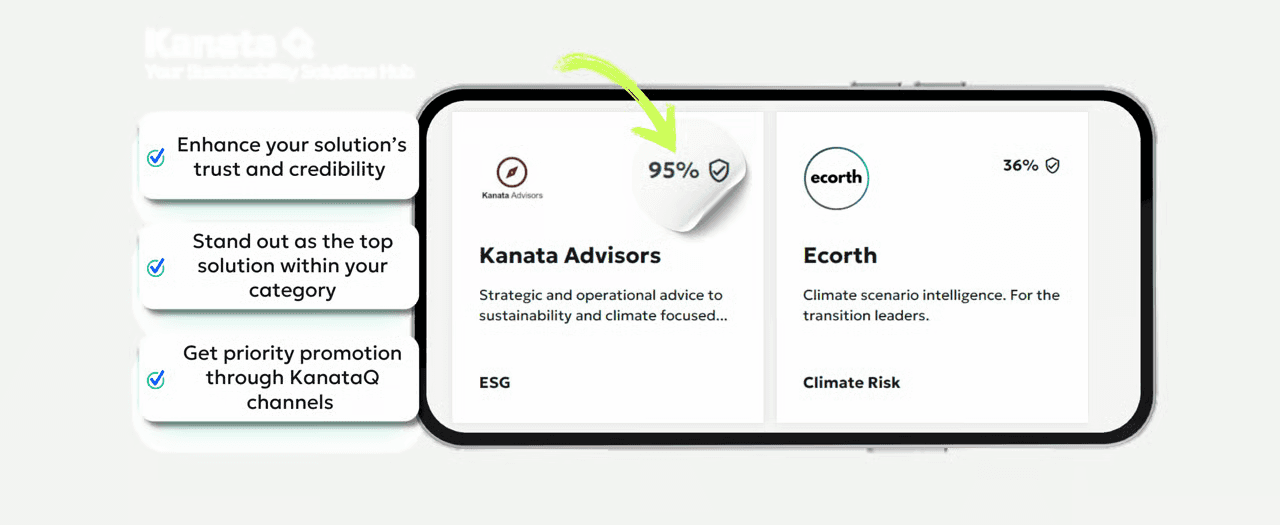
Take KanataQ as an example. KanataQ is building an ecosystem where sustainability challenges are addressed holistically. Companies can find software solutions for carbon accounting, access advisory services for ESG reporting, tap into climate risk analytics, and source biodiversity management tools—all within a unified platform. This model recognizes a fundamental truth: sustainability problems are complex and require multi-dimensional, interconnected solutions.
Why Ecosystems Matter
Complex Problems Require Systemic Solutions: Climate change isn’t just an energy problem. It's an infrastructure, agriculture, transportation, finance, and governance issue. A single tool addressing one fragment cannot fix a systemic failure. Ecosystems provide the cross-functional expertise needed to craft full-spectrum solutions.
Network Effects Drive Innovation: When multiple providers operate within a connected ecosystem, they share insights, data, and best practices. This accelerates innovation, improves interoperability, and ensures that sustainability solutions evolve alongside emerging market needs and regulatory changes.
Seamless User Experience: Sustainability leaders inside organizations are under immense pressure to act quickly and comprehensively. Ecosystem models reduce the friction of assembling fragmented tools by offering integrated, ready-to-scale solutions. This accelerates adoption and impact.
Stronger Trust and Accountability: When multiple players are interconnected, transparency improves. Companies can trace carbon accounting methodologies, ESG advisory quality, and climate data sources across the ecosystem. Trust is strengthened when accountability is distributed across a network, not confined to a black box.
The Risks of Lone Wolves
Solution providers operating in silos risk falling behind. Stand-alone carbon calculators, ESG rating services, or climate risk tools that cannot integrate or align with broader industry frameworks, or seamlessly interface with existing corporate technology infrastructure, will find themselves increasingly marginalized.
Moreover, lone wolves miss out on critical value creation opportunities that ecosystems enable: cross-sector collaborations, joint product development, bundled services, and access to pooled customer bases. In short, isolated solutions may work for niche problems, but they will not scale to meet the global challenge of sustainable development.
What Companies and Investors Should Prioritize
When evaluating sustainability partners or solution providers, companies and investors should ask: Is this solution designed to integrate with others, or is it a closed system? Does the provider actively collaborate within an ecosystem? How does the solution align with broader standards and frameworks? Can it evolve as regulatory expectations and stakeholder demands change? Those who prioritize ecosystem compatibility will future-proof their sustainability strategies and avoid becoming trapped in fragmented, outdated approaches.
The Future is Collaborative
The future belongs to those who build and participate in thriving ecosystems, where collaboration, innovation, and systemic thinking drive lasting change. Companies that understand this shift will not only achieve their sustainability goals faster; they will also build the trust, resilience, and competitive advantage needed for long-term success in a rapidly transforming world.
This article was originally published on May 7, 2025.
Bi-weekly insights, expert perspectives, and real-world updates on sustainability solutions
Join our 1K+ subscribers
On this page
Related articles


Ready to explore the market?
Discover trusted sustainability solutions, or list your own - free to get started